

The most critical thing that parent can do is to shape a secure attachment style in your child.
And yet so few parents understand this or know how to achieve it.
“The quality of early attachment shapes the blueprint for how we will relate to others throughout our lives.”

Find out your parenting attachment style
Parent/Caregiver Support Group
Join the Attachment Matters for Parent/Caregiver Community!
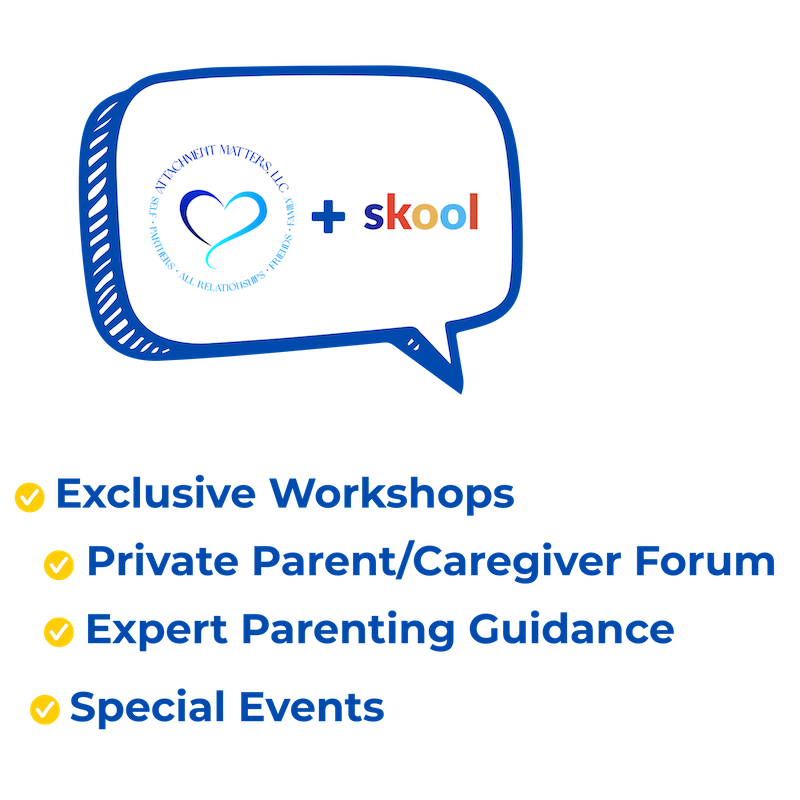
Your child’s emotional security starts with you. We’re here to help you build the strongest possible relationship with your child of any age using expert-backed strategies based on attachment science.
What You Get Inside:
- Expert Parenting Guidance – Get answers from top therapists & educators
- Private Parent Forum – Ask questions & receive real-time support
- Exclusive Workshops – Live & on-demand training to strengthen your parenting skills (additional fee for premium content)
- Live Q&A Calls – Monthly video calls with an attachment-informed therapist (optional upgrade)
- Special Event Access – Get invited to exclusive live & virtual events
Parenting workshops
To better equipped parents and caregivers, our parenting program is composed of two workshops.
Workshop 1: Understanding Attachment Theory:
Building Stronger Connections with Your Child
Learning Objectives
- Understand why Attachment Theory is crucial for raising emotionally healthy and happy children.
- Identify the four different attachment styles.
- Recognize the attachment style of your child.
- Learn strategies to support your child based on their attachment style.
- Briefly explore the concept of earned secure attachment as a positive pathway for growth.
Workshop 2 Part 1: The Science of Emotional Regulation
Understanding Your Child’s Brain and Attachment
Learning Objectives:
- Understand how each attachment style forms, including the core wounds, unmet needs, and coping mechanisms that emerge from early relational experiences
- Recognize the possibility of change: Identify specific internal factors (especially emotional regulation) that can shift a children’s position on the attachment spectrum toward greater security
- Grasp the neuroscience: Apply knowledge of brain development, the hand-brain model, epigenetics, and somatic science to understand why emotional regulation is particularly challenging for insecurely attached children
- Assess regulation capacity: Distinguish between the zones of tolerance for different attachment styles and recognize when their teen is dysregulated
- Take action: Implement tailored, attachment-style-specific strategies to support their children’s emotional regulation and movement toward secure attachment
Workshop 2 Part 2: The Practice of Co-Regulation—Communication, Repair & Becoming Your Child’s Secure Base
Learning Objectives:
- Regulate themselves first: Recognize how their own attachment style impacts their regulation capacity and implement specific strategies to stay grounded during their children’s dysregulation
- Co-regulate effectively: Understand and practice the five-step co-regulation process, adapting their approach based on their children’s attachment style
- Communicate with connection: Use attachment-informed language and the F.E.E.L. framework to maintain connection during conflict and foster emotional safety
- Repair ruptures skillfully: Execute the five-step repair process to transform inevitable conflicts into opportunities for building trust and security
- Create a secure relational environment: Implement the five pillars of secure attachment (predictability, attunement, safety, autonomy support, and repair culture) in their daily family life
- Know themselves: Identify their own adult attachment style and understand how it shows up in their parenting patterns
Workshop 1 Impact
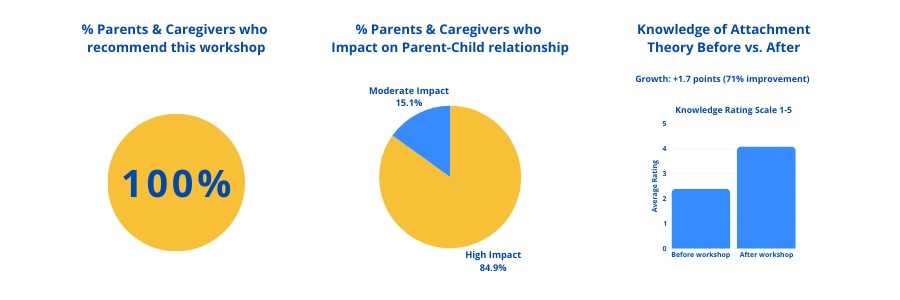
84.9% found that these workshops had a high Impact on their Parent/Caregivers-Child relationship
71% of parents and caregivers indicated improved knowledge of Attachment Theory post-workshop
Parent Testimonials
Parent/Caregiver Coaching Service
We offer one-on-one support to help you find clarity, learn practical tools, and build the confidence needed to foster secure attachment. Together, we’ll equip your children to thrive academically, socially, and emotionally. Together we’ll set them up to grow into teens and adults who build strong, healthy relationships in every area of life.
If you need personalized support, we’re here for you, ready to coach you step-by-step on your journey. To learn more, schedule your free consultation.