

-
Preschool to 8th
-
High School
-
Adult schools
Results-driven training to strengthen your entire school community
Our professional development, parent workshops, and student programs equip educators, caregivers, and students with practical tools for emotional intelligence, behavior management, and resilience.
Aligned with CASEL, Health Standards, and Teaching Practice Standards, our in- person and virtual sessions help improve classroom climate, reduce burnout, and boost student success.
Emotional intelligence and secure attachment are non-negotiable for college and career readiness.
With the Rise of AI, “Soft Skills” are changing to “Hard Skills”
The majority of the top 10 skills needed today and in 2030 require emotional intelligence (secure attachment)
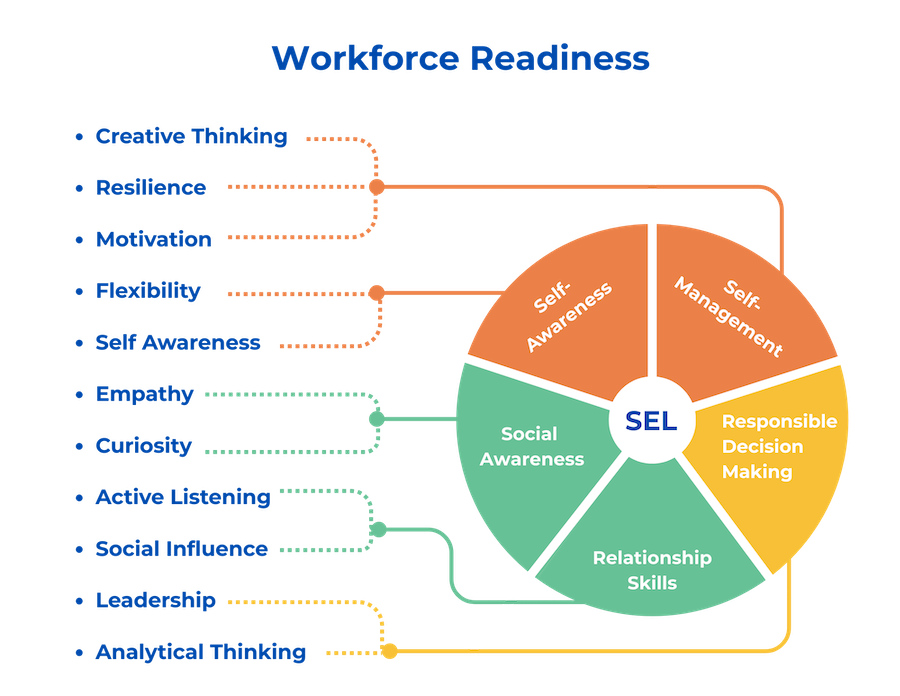
Collaborative for Academic, Social, and Emotional Learning (CASEL) hosted a webinar entitled The State of the Field 2026: Human Skills for a Changing World.
Their main message: To prepare students for 2030 workplace readiness, districts and schools must update their SEL plans to teach students durable human skills through relationships.
For decades, academic achievement has been the gold standard for workforce readiness. But academic mastery alone no longer prepares students for college and career success.
Social-emotional skills—what we call “durable human skills”—are equally critical, if not more so. The World Economic Forum projects that by 2030, creative thinking, resilience, and empathy will rank among employers’ most-needed skills.
Students with strong emotional intelligence demonstrate better collaboration, adaptability, problem-solving, and leadership—the competencies that drive real-world success. While Common Core addresses academics, true readiness requires intentionally developing students’ socialemotional foundations alongside cognitive skills.
Academics matter. But alone, they’re no longer enough.
Self regulation is the cornerstone of emotional intelligence (secure attachment). It has to be taught.
Why Self-Regulation Matters Now
%
of top performers have
high emotional intelligence
Year 2030
EQ skills will be even more valued
as AI handles routine tasks
Self-regulation is a cornerstone of emotional intelligence, enabling individuals to manage emotions, thoughts, and behaviors effectively in the classroom and the workplace.
Self Regulation is managing emotions and impulses; maintaining control and adaptability in challenging situations
The Five Components of Emotional Intelligence
Daniel Goleman’s Framework for Success
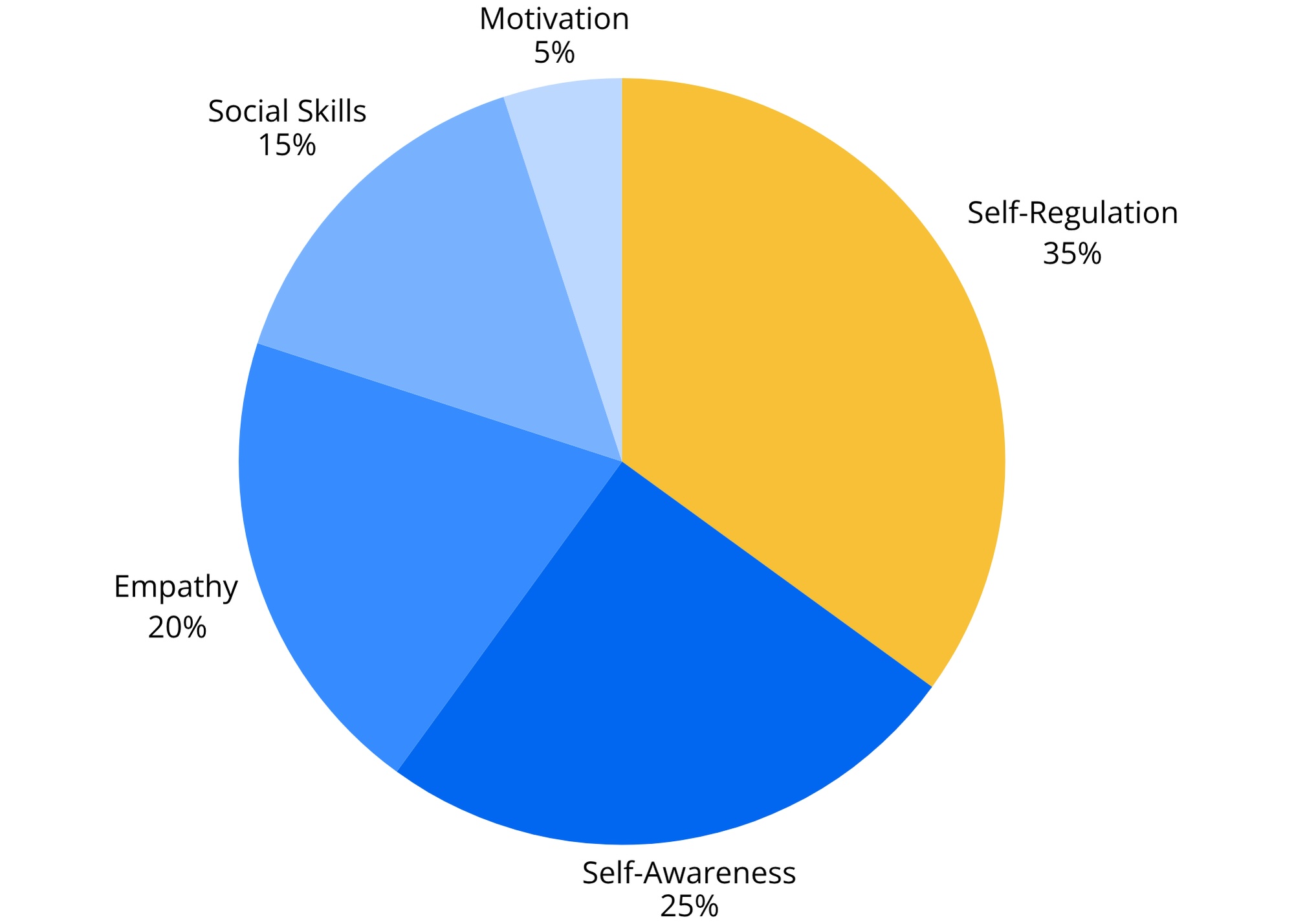
Source: Goleman, D. (1995). Emotional Intelligence: Why It Can Matter More Than IQ. New York: Bantam Books.
While Goleman’s original model presented five equally important components, practical application and subsequent research emphasize self- regulation as the foundational “control center” of emotional intelligence.
We can’t teach what we didn’t learn, but we can learn what we need to teach.
Why Attachment Matters in Preschool-8?

The Impact of Attachment Styles in Early Childhood Elementary Education
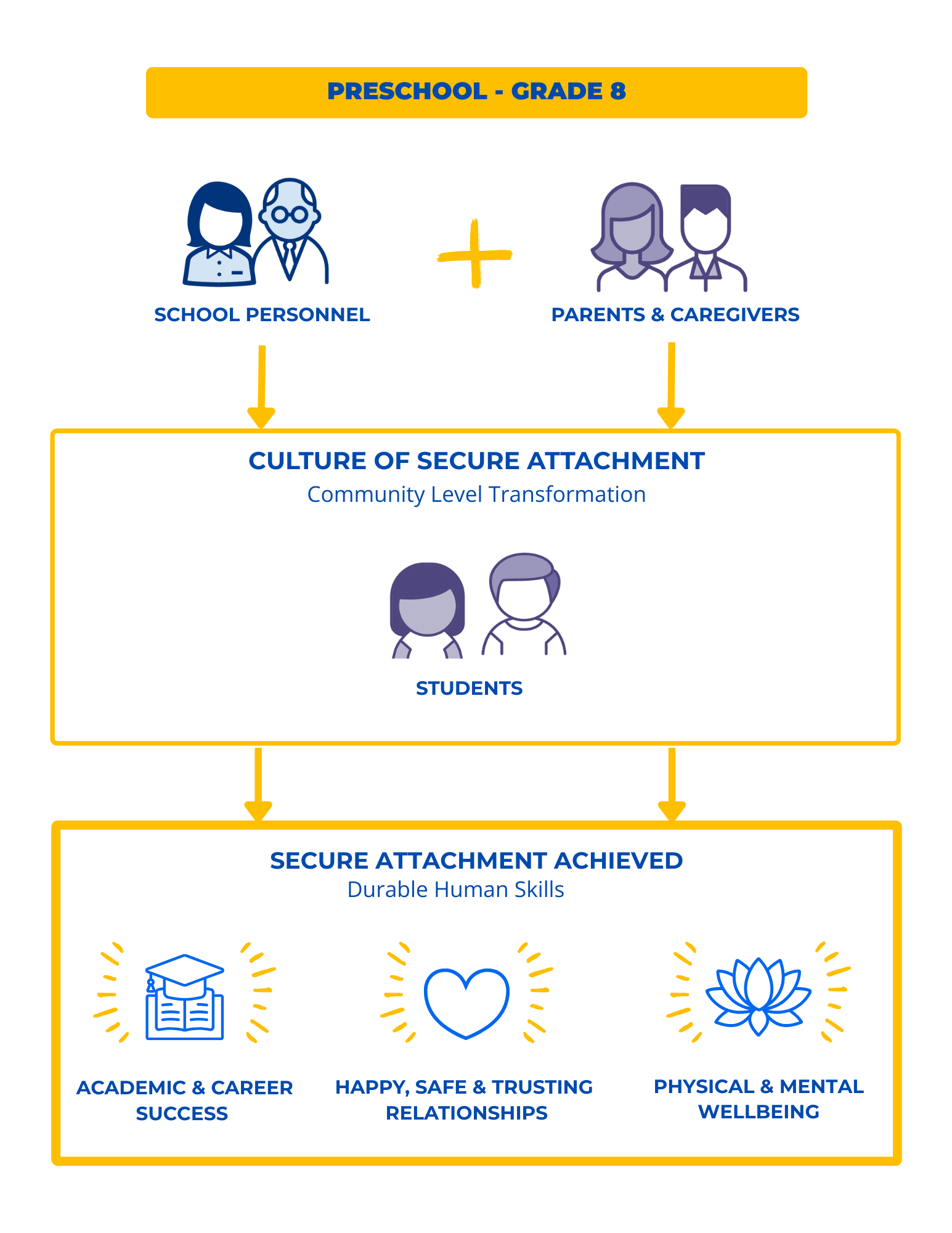
As children enter school, school personnel play a key role in shaping their emotional development and understanding of relationships. Creating emotionally safe environments is essential for academic success, emotional regulation, and positive social interactions.
School Personnel Can Foster Emotional Safety Through Attachment Awareness
- Recognize diverse emotional needs shaped by attachment styles.
- Build trusting relationships to support academic and social growth.
- Provide structure and predictability for insecurely attached children.
- Foster emotional regulation and conflict resolution skills.
Parent-Teacher Collaboration for Emotional Growth
When parents and school personnel understand attachment theory, they cna create a consistent, emotionally safe environment for children at home and school, supporting their emotional and academic development throughout Kindergarten to 8th grade.
Spotlight on Research
Primary education teachers can be considered as attachment figures, and an emotional secure base for the students.
García-Rodríguez, L., Iriarte Redín, C., & Reparaz Abaitua, C. (2023). Teacher-student attachment relationship, variables associated, and measurement: A systematic review. Educational Research Review, 38, 100488.
Discover the urgency for attachment-based education at your school/district
In-Person/Virtual Workshops
Educator Workshops
Workshop 1: Understanding Attachment Styles to Enhance Student Relationships
This 90-minute workshop introduces educators to attachment theory and its critical role in shaping teacher-student relationships. Participants will explore how attachment develops over time and influences students’ social interactions, academic success, and behaviors. Through practical insights, teachers will learn to identify different attachment styles—secure, anxious-preoccupied, dismissive-avoidant, and fearful-avoidant—and discover strategies to support the unique emotional and academic needs of each student. By the end of the session, educators will have a deeper understanding of how to foster stronger, more attuned relationships that promote emotional safety, resilience, and academic growth in the classroom.
Key Objectives:
- Understand the importance of attachment in teacher-student relationships.
- Learn how attachment develops and shapes individuals over time.
- Identify attachment styles and their impact on students’ behaviors and success.
- Gain strategies to recognize and support students’ attachment needs.
Workshop 2: Building Secure Classrooms: Attachment-Based Teaching, Emotional-Regulation, and Emotional Well-Being
A Two-Part Professional Development Series for Educators
Part 1: How Attachment Patterns Affect Student Emotional Regulation
This 90-minute foundational workshop explores how early attachment experiences shape students’ capacity for emotional regulation—the cornerstone of academic, social, and future career success. Educators will learn how insecure attachment patterns form in the home, the core wounds and coping mechanisms that drive challenging classroom behaviors, and specific intervention strategies to interrupt dysregulation and help students build new, healthier emotional responses. Through case studies and practical application, participants will develop a deeper understanding of the “why” behind student behavior and gain concrete tools to support regulatory development.
Key Objectives:
- Illuminate Root Causes: Connect early caregiving patterns to students’ core wounds, needs, and coping strategies that surface as classroom behaviors.
- Center Self-Regulation: Clarify why self-regulation—not IQ—is the cornerstone of academic, social, and life outcomes.
- Target the Chain: Show where dysregulation unfolds and identify precise intervention points to change the trajectory in real time.
- Make It Practical: Equip educators with differentiated, attachment-informed strategies that help students rewire regulation patterns over time.
Part 2: Creating a Secure Classroom Through Educator Regulation
Building on the foundation of Part 1, this 90-minute session focuses on the most critical factor in creating a secure classroom: the educator’s own regulated nervous system. Participants will explore what happens neurologically when students trigger their stress response, how their personal attachment style influences their teaching and classroom management, and why self-regulation is essential for effective co-regulation. Through experiential practice and personalized planning, educators will learn in-the-moment regulation tools they can use while teaching, strategies for creating a secure classroom environment through their own emotional presence, and sustainable self-care practices to prevent burnout while doing this demanding work.
Key Objectives:
- Deepen Awareness of Internal Regulation: Help educators recognize their own physiological stress responses, emotional triggers, and body cues that arise during challenging classroom moments.
- Connect Attachment Style to Teaching Practice: Explore how each educator’s attachment pattern—anxious, avoidant, fearful-avoidant (disorganized), or secure—influences their classroom management, relational style, and communication with students.
- Strengthen the Science of Co-Regulation: Illustrate how a calm and regulated educator’s nervous system supports student safety and regulation through mirror neurons and attuned emotional presence.
- Integrate Sustainable Regulation and Self-Care Practices: Equip educators with personalized regulation tools and ongoing self-care strategies to maintain emotional steadiness, prevent burnout, and consistently model secure attachment in the classroom.
Counselors & Mental Health Clinician Workshops
Workshop 1: Understanding Attachment Theory to Transform Student Support
This 90-minute foundational workshop introduces school counselors and social workers to attachment theory and its powerful applications in school-based mental health practice. Participants will explore how attachment develops through early caregiving relationships and continues to shape students’ emotional wellbeing, behaviors, and presenting concerns throughout their school years. Through practical case examples relevant to counseling and social work, professionals will learn to identify the four primary attachment styles—secure, anxious-preoccupied, dismissive-avoidant, and fearful-avoidant (disorganized)—and understand how these patterns show up in intake sessions, individual counseling, crisis situations, and interactions with peers and adults. By the end of the session, participants will have a foundational framework for viewing student challenges through an attachment lens and beginning to integrate attachment-informed approaches into their daily practice.
Key Objectives:
- Understand Core Attachment Styles: Build foundational knowledge of the four attachment styles, how these relational patterns develop in early childhood, and how they continue to influence students’ emotional and behavioral functioning.
- Recognize Attachment Patterns in Student Presenting Concerns: Learn to identify how different attachment styles manifest in common referral issues—anxiety, depression, behavioral problems, peer conflict, family struggles, and academic disengagement—reframing these challenges as attachment-based needs rather than isolated symptoms.
- Begin Applying Attachment-Informed Support Strategies: Discover practical, relationship-based approaches tailored to each attachment style that school counselors and social workers can immediately implement to build trust, promote emotional safety, and support student growth within the therapeutic relationship.
Workshop 2: Attachment-Informed Crisis Response & Systems Support
A Two-Part Professional Development Series for School Counselors and Social Workers
Part 1: Attachment Patterns, Student Dysregulation, and the Power of Co-Regulation
This 90-minute foundational workshop explores how attachment patterns profoundly shape students’ capacity for emotional regulation—the cornerstone of mental health, academic success, and healthy relationships. School counselors and social workers will learn how insecure attachment patterns formed in early caregiving relationships create specific regulatory challenges that manifest as anxiety, depression, behavioral crises, and relational struggles. Participants will discover why certain students escalate while others shut down, understand the core wounds and coping mechanisms driving these patterns, and learn the science of co-regulation—how your own regulated nervous system becomes the most powerful intervention tool. Through case examples and practical application, professionals will gain concrete strategies for helping students build new regulatory capacities within the safety of the therapeutic relationship.
Key Objectives:
- Illuminate the Attachment-Regulation Connection: Understand how early caregiving patterns create core wounds and coping mechanisms that drive students’ regulatory struggles, and why self-regulation—not cognitive ability—is foundational to mental health and life success.
- Master Co-Regulation as Clinical Intervention: Learn the neuroscience of how your calm, regulated presence supports student regulation through mirror neurons and attuned connection, and discover attachment-specific co-regulation strategies for crisis intervention and ongoing therapeutic work.
- Build Differentiated Regulation Support: Gain practical, attachment-informed techniques tailored to each attachment style that help students interrupt dysregulation patterns, strengthen regulatory skills, and develop secure pathways to emotional safety.
Part 2: The Regulated Professional: Navigating Multiple Attachment Systems to Support Student Success
Building on Part 1, this 90-minute session focuses on the most critical and complex aspect of school-based mental health work: the counselor or social worker’s ability to remain regulated while navigating the intersecting attachment styles of students, teachers, and parents/caregivers. Participants will explore what happens neurologically when challenging cases, resistant families, or overwhelmed teachers trigger their stress response, and how their personal attachment style influences every consultation, family meeting, and therapeutic relationship. The session then expands to address the unique systemic challenge counselors and social workers face: students exist at the intersection of multiple attachment relationships, and supporting them requires understanding and strategically working with the attachment patterns of ALL the adults in their world. Through experiential practice, case analysis, and personalized planning, professionals will learn in-the-moment regulation tools, skills for recognizing attachment styles in teachers and parents, and concrete strategies for navigating conflicting attachment dynamics to build collaborative support systems. This session empowers mental health professionals to lead attachment-informed change from a foundation of personal regulation while skillfully managing the complex relational web that surrounds each student.
Key Objectives:
- Establish Self-Regulation as Your Foundation: Deepen awareness of your own physiological stress responses, emotional triggers, and attachment style, recognizing how these influence your clinical work, consultation approach, boundary-setting, and capacity for systems advocacy—and learn personalized regulation tools to maintain steady presence during challenging moments.
- Recognize and Work With Teacher and Parent Attachment Styles: Develop skills to identify attachment patterns in the educators and caregivers you consult with, understanding how anxious, avoidant, fearful-avoidant (disorganized), or secure styles shape their responses to student struggles, their openness to feedback, and their capacity for collaboration.
- Navigate Complex Attachment Triangles: Learn practical strategies for working with students who sit at the intersection of multiple attachment relationships—how to support an anxious student with a dismissive teacher and an anxious parent, or manage dynamics when adult attachment styles clash and create barriers to student support.
- Lead System Change Through Regulated, Attuned Presence: Understand how your calm nervous system creates safety not only for students but also for the stressed educators and defensive families you work with, strengthening your influence as a bridge-builder, and integrate sustainable self-care practices to prevent compassion fatigue while consistently modeling secure attachment across all school relationships.
District and School site Leadership workshop (Coming Soon!)
Family Workshops
Workshop 1: Understanding Attachment Theory: Building Stronger Connections with Your Child
This 90-minute workshop is designed to deepen your understanding of the vital role attachment plays in raising emotionally healthy and happy children. In this session, you will learn about the four primary attachment styles, how to recognize them in your child, and explore practical strategies to foster a secure attachment environment. Whether you’re a parent or caregiver, this workshop will provide valuable insights to help you strengthen your relationship with your child and create a nurturing, emotionally supportive home.
Workshop 2: Parenting for Secure Attachment: Supporting Your Child's Emotional Growth
A Two-Part Workshop Series for Parents and Caregivers of Children.
Part 1: The Science of Emotional Regulation—Understanding Your Child’s Brain and Attachment
This 90-minute interactive workshop dives deep into how attachment styles develop and, most importantly, what parents can do right now to support their children’s journey toward secure attachment. Parents will learn the neuroscience behind why insecurely attached children struggle with emotional regulation, understand the “zone of tolerance” concept, and leave with concrete, attachment-style-specific strategies they can implement immediately. Through hands-on activities and visual models, parents will grasp how internal factors—particularly emotional regulation—serve as the cornerstone for shifting attachment patterns and fostering resilience in their children.
Key Objectives:
- Understand the origins: Explain how each attachment style forms, including the core wounds, unmet needs, and coping mechanisms that emerge from early relational experiences
- Recognize the possibility of change: Identify specific internal factors (especially emotional regulation) that can shift a children’s position on the attachment spectrum toward greater security
- Grasp the neuroscience: Apply knowledge of brain development, the hand-brain model, epigenetics, and somatic science to understand why emotional regulation is particularly challenging for insecurely attached children
- Assess regulation capacity: Distinguish between the zones of tolerance for different attachment styles and recognize when their teen is dysregulated
- Take action: Implement tailored, attachment-style-specific strategies to support their children’s emotional regulation and movement toward secure attachment
Part 2: The Practice of Co-Regulation—Communication, Repair & Becoming Your Child’s Secure Base
This 90-minute interactive workshop focuses on the most powerful external factor in your children’s attachment journey: YOU. Parents will discover how their own attachment style impacts their ability to stay regulated during their children’s emotional storms, learn the art of co-regulation, and practice communication strategies that build connection rather than create distance. Through hands-on role-plays and real-world scenarios, you’ll master the rupture-repair process and understand how to create a home environment where secure attachment can flourish. The session concludes with a personal attachment style assessment, helping you understand your own patterns so you can parent more intentionally and effectively.
Key Objectives:
- Regulate themselves first: Recognize how their own attachment style impacts their regulation capacity and implement specific strategies to stay grounded during their children’s dysregulation
- Co-regulate effectively: Understand and practice the five-step co-regulation process, adapting their approach based on their children’s attachment style
- Communicate with connection: Use attachment-informed language and the F.E.E.L. framework to maintain connection during conflict and foster emotional safety
- Repair ruptures skillfully: Execute the five-step repair process to transform inevitable conflicts into opportunities for building trust and security
- Create a secure relational environment: Implement the five pillars of secure attachment (predictability, attunement, safety, autonomy support, and repair culture) in their daily family life
- Know themselves: Identify their own adult attachment style and understand how it shows up in their parenting patterns
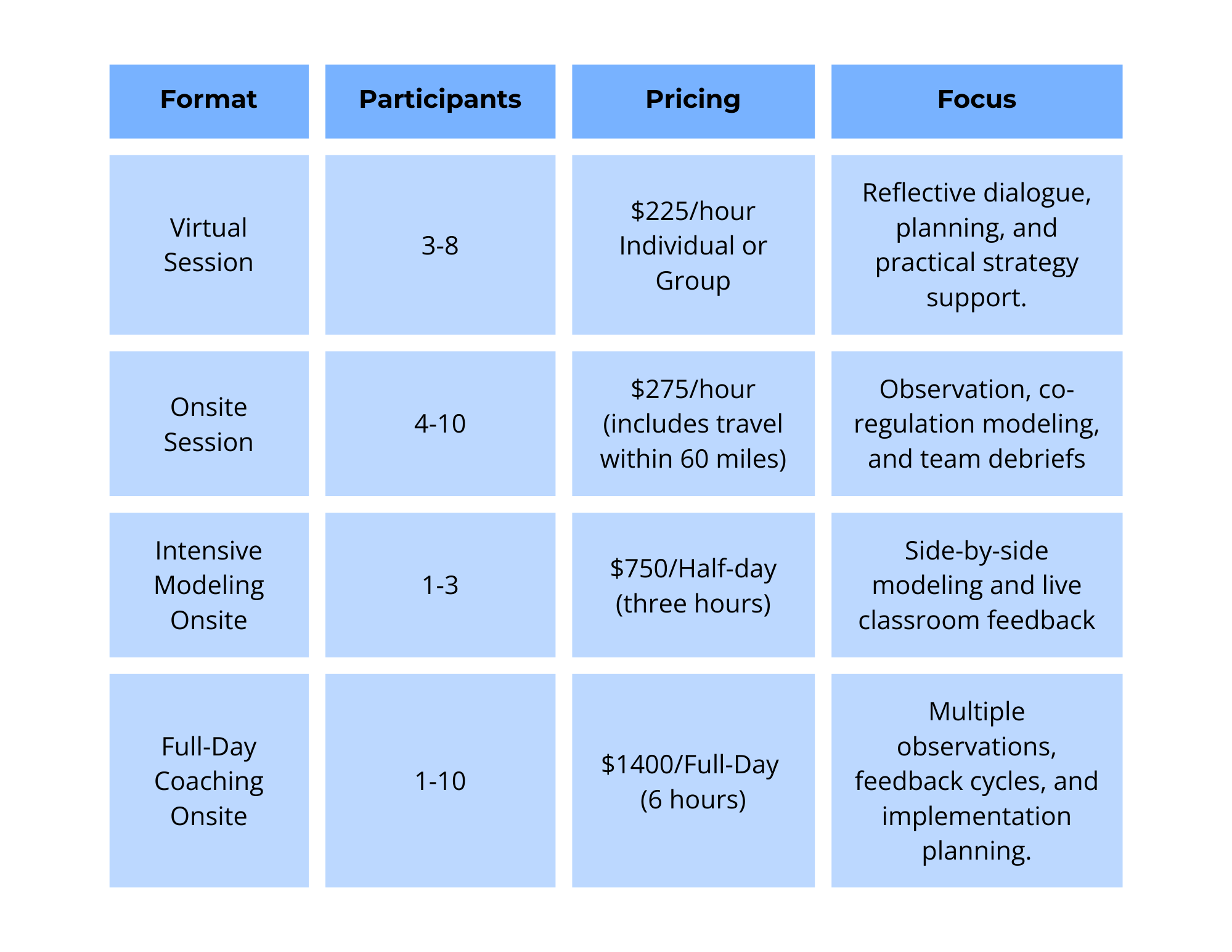
Coaching Add-Ons
Why Attachment Matters in High School?

The Impact of Attachment Styles in High School
Attachment—the emotional bond formed with primary caregivers in early childhood – shapes how individuals relate to others and manage stress throughout their lives. These early attachment experiences continue to influence how high school students handle peer relationships, academic challenges, and emotional regulation.
Students with secure attachment tend to feel confident in social settings and academic pursuits, while those with insecure attachment may struggle with trust, fear of rejection, or emotional disregulation under pressure.
In High Schools, Relationships Are Crucial
Awareness of attachment impacts key decision-making for high school students, including choices about consent and drug use. As students navigate adolescence, school personnel and parents play a crucial role in shaping their emotional development and relationships. Creating emotionally safe environments is essential for their academic success, emotional well-being, and positive social interactions.
Awareness of Attachment Styles Matters for All
- For school personnel: Understanding attachment helps provide personalized support, build trust, and foster emotional regulation.
- For Students: Knowing their attachment style helps manage stress, improve relationships, and boost academic performance.
- For Parents: Recognizing attachment style helps reinforce emotional safety at home
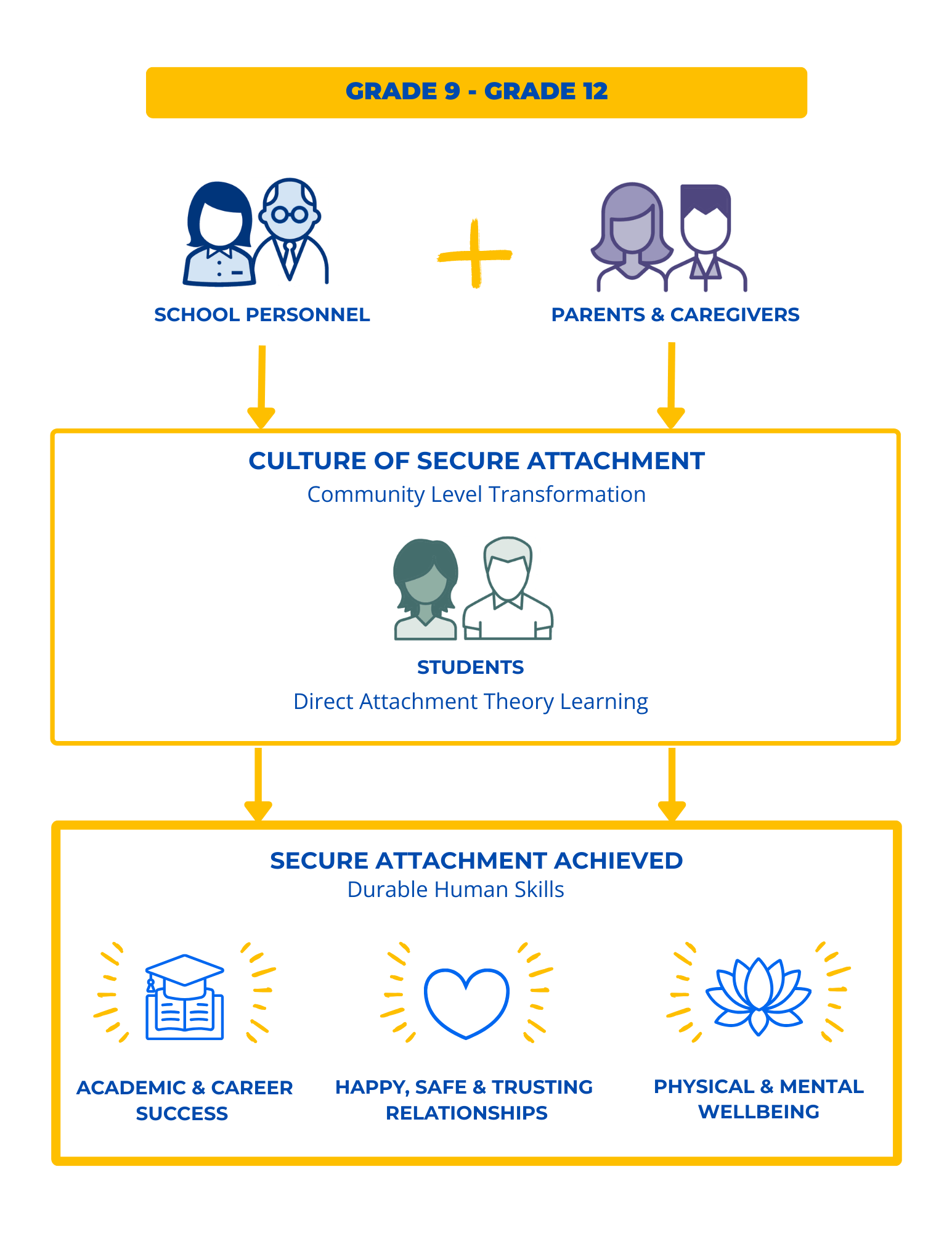
When school personnel, parents, and students collaborate, they create a stronger foundation for emotional and academic growth.
Spotlight on Research
Secure attachment is a protective factor in adolescence, predicting healthier peer and romantic relationships (Allen & Tan, 2016), lower risk of depression and anxiety (Moretti & Peled, 2004; Lee & Hankin, 2009), and stronger emotional regulation skills (Zimmermann, Maier, Winter, & Grossmann, 2001; Kobak & Madsen, 2008).
Discover the urgency for attachment-based education at your school/district
In-Person/Virtual Workshops
Educator Workshops
Understanding Attachment Styles to Enhance Student Relationships
Key Objectives:
- Understand the importance of attachment in teacher-student relationships.
- Learn how attachment develops and shapes individuals over time.
- Identify attachment styles and their impact on students’ behaviors and success.
- Gain strategies to recognize and support students’ attachment needs.
Building Secure Classrooms: Attachment-Based Teaching, Emotional-Regulation, and Emotional Well-Being
A Two-Part Professional Development Series for Educators
Part 1: How Attachment Patterns Affect Student Emotional Regulation
This 90-minute foundational workshop explores how early attachment experiences shape students’ capacity for emotional regulation—the cornerstone of academic, social, and future career success. Educators will learn how insecure attachment patterns form in the home, the core wounds and coping mechanisms that drive challenging classroom behaviors, and specific intervention strategies to interrupt dysregulation and help students build new, healthier emotional responses. Through case studies and practical application, participants will develop a deeper understanding of the “why” behind student behavior and gain concrete tools to support regulatory development.
Key Objectives:
- Illuminate Root Causes: Connect early caregiving patterns to students’ core wounds, needs, and coping strategies that surface as classroom behaviors.
- Center Self-Regulation: Clarify why self-regulation—not IQ—is the cornerstone of academic, social, and life outcomes.
- Target the Chain: Show where dysregulation unfolds and identify precise intervention points to change the trajectory in real time.
- Make It Practical: Equip educators with differentiated, attachment-informed strategies that help students rewire regulation patterns over time.
Part 2: Creating a Secure Classroom Through Educator Regulation
Building on the foundation of Part 1, this 90-minute session focuses on the most critical factor in creating a secure classroom: the educator’s own regulated nervous system. Participants will explore what happens neurologically when students trigger their stress response, how their personal attachment style influences their teaching and classroom management, and why self-regulation is essential for effective co-regulation. Through experiential practice and personalized planning, educators will learn in-the-moment regulation tools they can use while teaching, strategies for creating a secure classroom environment through their own emotional presence, and sustainable self-care practices to prevent burnout while doing this demanding work.
Key Objectives:
- Deepen Awareness of Internal Regulation: Help educators recognize their own physiological stress responses, emotional triggers, and body cues that arise during challenging classroom moments.
- Connect Attachment Style to Teaching Practice: Explore how each educator’s attachment pattern—anxious, avoidant, fearful-avoidant (disorganized), or secure—influences their classroom management, relational style, and communication with students.
- Strengthen the Science of Co-Regulation: Illustrate how a calm and regulated educator’s nervous system supports student safety and regulation through mirror neurons and attuned emotional presence.
- Integrate Sustainable Regulation and Self-Care Practices: Equip educators with personalized regulation tools and ongoing self-care strategies to maintain emotional steadiness, prevent burnout, and consistently model secure attachment in the classroom.
School Counselors, Social Workers, & Other Mental Health Staff
Workshop 1: Understanding Attachment Theory to Transform Student Support
This 90-minute foundational workshop introduces school counselors and social workers to attachment theory and its powerful applications in school-based mental health practice. Participants will explore how attachment develops through early caregiving relationships and continues to shape students’ emotional wellbeing, behaviors, and presenting concerns throughout their school years. Through practical case examples relevant to counseling and social work, professionals will learn to identify the four primary attachment styles—secure, anxious-preoccupied, dismissive-avoidant, and fearful-avoidant (disorganized)—and understand how these patterns show up in intake sessions, individual counseling, crisis situations, and interactions with peers and adults. By the end of the session, participants will have a foundational framework for viewing student challenges through an attachment lens and beginning to integrate attachment-informed approaches into their daily practice.
Key Objectives:
- Understand Core Attachment Styles: Build foundational knowledge of the four attachment styles, how these relational patterns develop in early childhood, and how they continue to influence students’ emotional and behavioral functioning.
- Recognize Attachment Patterns in Student Presenting Concerns: Learn to identify how different attachment styles manifest in common referral issues—anxiety, depression, behavioral problems, peer conflict, family struggles, and academic disengagement—reframing these challenges as attachment-based needs rather than isolated symptoms.
- Begin Applying Attachment-Informed Support Strategies: Discover practical, relationship-based approaches tailored to each attachment style that school counselors and social workers can immediately implement to build trust, promote emotional safety, and support student growth within the therapeutic relationship.
Workshop 2: Attachment-Informed Crisis Response & Systems Support
A Two-Part Professional Development Series for Educators
Part 1: Attachment Patterns, Student Dysregulation, and the Power of Co-Regulation
This 90-minute foundational workshop explores how attachment patterns profoundly shape students’ capacity for emotional regulation—the cornerstone of mental health, academic success, and healthy relationships. School counselors and social workers will learn how insecure attachment patterns formed in early caregiving relationships create specific regulatory challenges that manifest as anxiety, depression, behavioral crises, and relational struggles. Participants will discover why certain students escalate while others shut down, understand the core wounds and coping mechanisms driving these patterns, and learn the science of co-regulation—how your own regulated nervous system becomes the most powerful intervention tool. Through case examples and practical application, professionals will gain concrete strategies for helping students build new regulatory capacities within the safety of the therapeutic relationship.
Key Objectives:
- Illuminate the Attachment-Regulation Connection: Understand how early caregiving patterns create core wounds and coping mechanisms that drive students’ regulatory struggles, and why self-regulation—not cognitive ability—is foundational to mental health and life success.
- Master Co-Regulation as Clinical Intervention: Learn the neuroscience of how your calm, regulated presence supports student regulation through mirror neurons and attuned connection, and discover attachment-specific co-regulation strategies for crisis intervention and ongoing therapeutic work.
- Build Differentiated Regulation Support: Gain practical, attachment-informed techniques tailored to each attachment style that help students interrupt dysregulation patterns, strengthen regulatory skills, and develop secure pathways to emotional safety.
Part 2: The Regulated Professional: Navigating Multiple Attachment Systems to Support Student Success
Building on Part 1, this 90-minute session focuses on the most critical and complex aspect of school-based mental health work: the counselor or social worker’s ability to remain regulated while navigating the intersecting attachment styles of students, teachers, and parents/caregivers. Participants will explore what happens neurologically when challenging cases, resistant families, or overwhelmed teachers trigger their stress response, and how their personal attachment style influences every consultation, family meeting, and therapeutic relationship. The session then expands to address the unique systemic challenge counselors and social workers face: students exist at the intersection of multiple attachment relationships, and supporting them requires understanding and strategically working with the attachment patterns of ALL the adults in their world. Through experiential practice, case analysis, and personalized planning, professionals will learn in-the-moment regulation tools, skills for recognizing attachment styles in teachers and parents, and concrete strategies for navigating conflicting attachment dynamics to build collaborative support systems. This session empowers mental health professionals to lead attachment-informed change from a foundation of personal regulation while skillfully managing the complex relational web that surrounds each student.
Key Objectives:
- Establish Self-Regulation as Your Foundation: Deepen awareness of your own physiological stress responses, emotional triggers, and attachment style, recognizing how these influence your clinical work, consultation approach, boundary-setting, and capacity for systems advocacy—and learn personalized regulation tools to maintain steady presence during challenging moments.
- Recognize and Work With Teacher and Parent Attachment Styles: Develop skills to identify attachment patterns in the educators and caregivers you consult with, understanding how anxious, avoidant, fearful-avoidant (disorganized), or secure styles shape their responses to student struggles, their openness to feedback, and their capacity for collaboration.
- Navigate Complex Attachment Triangles: Learn practical strategies for working with students who sit at the intersection of multiple attachment relationships—how to support an anxious student with a dismissive teacher and an anxious parent, or manage dynamics when adult attachment styles clash and create barriers to student support.
- Lead System Change Through Regulated, Attuned Presence: Understand how your calm nervous system creates safety not only for students but also for the stressed educators and defensive families you work with, strengthening your influence as a bridge-builder, and integrate sustainable self-care practices to prevent compassion fatigue while consistently modeling secure attachment across all school relationships..
Leadership workshop (Coming Soon!)
Family Workshop
Workshop 1: Understanding Attachment Theory: Building Stronger Connections with Your Teen
This 90-minute workshop will introduce participants to attachment theory and its vital role in fostering emotionally healthy, resilient, and happy teens. Through understanding the different attachment styles, parents and caregivers will gain practical tools for recognizing their child’s attachment style and how to respond in a way that supports their emotional growth. The session will conclude with a brief discussion on earned secure attachment as an inspiring way to foster growth in both teens and adults.
Key Objectives:
- Understand the Role of Attachment in Emotional Health: Explore how attachment shapes teens’ emotional well-being, resilience, and happiness through daily moments of connection, comfort, and repair.
- Identify the Four Attachment Styles: Learn to distinguish Secure, Anxious-Preoccupied, Dismissive-Avoidant, and Fearful-Avoidant (Disorganized) patterns and how each influences a child’s emotional development and relationships.
- Recognize and Support Your Teen’s Attachment Needs: Observe your child’s cues and apply attuned, consistent responses that foster security, emotional growth, and trust.
- Embrace the Path to Earned Secure Attachment: Discover how both teens and adults can heal and grow toward greater emotional security, creating stronger, more connected family relationships.
Workshop 2: Parenting for Secure Attachment: Supporting Your Teen's Emotional Growth
A Two-Part Workshop Series for Parents and Caregivers of Adolescents
Part 1: The Science of Emotional Regulation—Understanding Your Teen’s Brain and Attachment
This 90-minute interactive workshop dives deep into how attachment styles develop and, most importantly, what parents can do right now to support their teen’s journey toward secure attachment. Parents will learn the neuroscience behind why insecurely attached teens struggle with emotional regulation, understand the “zone of tolerance” concept, and leave with concrete, attachment-style-specific strategies they can implement immediately. Through hands-on activities and visual models, parents will grasp how internal factors—particularly emotional regulation—serve as the cornerstone for shifting attachment patterns and fostering resilience in their teens.
Key Objectives:
- Understand the origins: Explain how each attachment style forms, including the core wounds, unmet needs, and coping mechanisms that emerge from early relational experiences
- Recognize the possibility of change: Identify specific internal factors (especially emotional regulation) that can shift a teen’s position on the attachment spectrum toward greater security
- Grasp the neuroscience: Apply knowledge of brain development, the hand-brain model, epigenetics, and somatic science to understand why emotional regulation is particularly challenging for insecurely attached teens
- Assess regulation capacity: Distinguish between the zones of tolerance for different attachment styles and recognize when their teen is dysregulated
- Take action: Implement tailored, attachment-style-specific strategies to support their teen’s emotional regulation and movement toward secure attachment
Part 2: The Practice of Co-Regulation—Communication, Repair & Becoming Your Teen’s Secure Base
This 90-minute interactive workshop focuses on the most powerful external factor in your teen’s attachment journey: YOU. Parents will discover how their own attachment style impacts their ability to stay regulated during their teen’s emotional storms, learn the art of co-regulation, and practice communication strategies that build connection rather than create distance. Through hands-on role-plays and real-world scenarios, you’ll master the rupture-repair process and understand how to create a home environment where secure attachment can flourish. The session concludes with a personal attachment style assessment, helping you understand your own patterns so you can parent more intentionally and effectively.
Key Objectives:
- Regulate themselves first: Recognize how their own attachment style impacts their regulation capacity and implement specific strategies to stay grounded during their teen’s dysregulation
- Co-regulate effectively: Understand and practice the five-step co-regulation process, adapting their approach based on their teen’s attachment style
- Communicate with connection: Use attachment-informed language and the F.E.E.L. framework to maintain connection during conflict and foster emotional safety
- Repair ruptures skillfully: Execute the five-step repair process to transform inevitable conflicts into opportunities for building trust and security
- Create a secure relational environment: Implement the five pillars of secure attachment (predictability, attunement, safety, autonomy support, and repair culture) in their daily family life
- Know themselves: Identify their own adult attachment style and understand how it shows up in their parenting patterns
Coaching Add-Ons
Student Workshops
This workshop series empowers teens to understand and navigate relationships through the lens of Attachment Theory. By exploring the four attachment styles and developing earned secure strategies, students build emotional regulation, communication, and self-awareness, leading to stronger academic performance, healthier relationships, and greater confidence in future careers.
Secure Connections Student Workshop Series
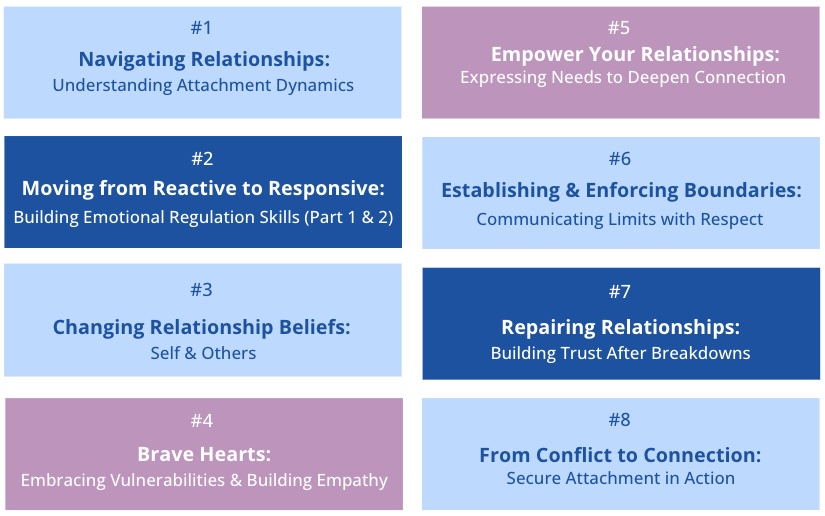
Workshop Progression
Workshops 1–3
Internal Foundation:
Understanding attachment, emotions & beliefs
Workshops 4–6
Interpersonal Skill-building:
vulnerability, expressing needs, & boundary-setting
Workshops 7–8
Advanced relationship skill
#1 - Navigating Relationships
Overview:
This workshop aims to equip adults with essential insights into Attachment Theory, fostering a deeper understanding of how attachment styles influence their relationships. Participants will explore diverse attachment styles and learn that these styles are fluid, with the potential for growth towards earned secure attachment.
Learning Targets:
- Understand the significance of Attachment Theory in shaping relationships and emotional bonds.
- Recognize and differentiate between diverse attachment styles, including secure, anxious-preoccupied, dismissive-avoidant, and fearful-avoidant.
- Grasp the concept of fluidity in attachment styles and comprehend that these styles can evolve over time.
- Realize the potential for growth towards earned secure attachment through self-awareness and intentional relationship-building.
#2 - Moving from Reactive to Responsive
Part 1: Understanding Your Emotional Patterns
Short Description:
In this foundational workshop, teens explore how their early experiences and relationships have shaped the way they handle emotions today. Through interactive activities and relatable scenarios, students will discover why they might worry excessively, shut down, push others away, or cling harder when stressed—and learn that these patterns reflect insecure attachment styles that once served as protection but may no longer serve them well. Participants will identify their own stress responses, understand the core wounds and needs driving their behaviors, and recognize their maladaptive coping mechanisms. Most importantly, teens will learn that these patterns are not fixed—they can be reshaped into secure, healthy responses through awareness and practice, building the foundation for the practical regulation skills taught in Workshop 2.
Learning Objectives:
By the end of Workshop 1, participants will be able to:
- Explain how anxious-preoccupied, dismissive-avoidant, and fearful-avoidant attachment patterns develop based on early relationship experiences
- Identify their own primary attachment pattern and recognize how it shows up in their relationships and stress responses
- Describe the core wound (deep fear), core need, and typical coping mechanisms associated with each insecure attachment style
- Analyze how their coping mechanisms, while originally protective, often backfire and create the exact outcomes they fear (abandonment, rejection, chaos)
- Recognize what they are truly seeking when they react (connection, safety, control) and understand the difference between their needs and their strategies
- Articulate that insecure attachment patterns are learned responses—not permanent personality traits—and can be rewired toward secure attachment through awareness and intentional practice
Part 2: Taking Control of Your Responses
Short Description:
Building on the self-awareness developed in Workshop 1, this action-oriented workshop teaches teens the science behind their stress responses and provides practical tools to create new, secure patterns in real time. Students will learn what happens in their brain and body when their attachment style is triggered, how to recognize their personal early warning signals, and most importantly—how to pause before reacting automatically. Through hands-on practice, teens will learn specific regulation strategies for both “revved up” (hyperaroused) and “shut down” (hypoaroused) states, and develop a personalized regulation plan. The workshop concludes with daily practices that rewire the nervous system over time, helping teens build the self-regulation skills that are essential for healthy relationships, academic success, and future career readiness.
Learning Objectives:
By the end of Workshop 2, participants will be able to:
- Explain what happens neurologically, chemically, and somatically when someone with an insecure attachment style feels triggered (amygdala activation, stress hormones, prefrontal cortex going offline)
- Identify their personal early warning signals—the specific body sensations, thoughts, and urges that indicate they are becoming dysregulated
- Demonstrate the STOP technique (Stop, Take breaths, Observe, Proceed) to create a pause between trigger and automatic reaction
- Apply appropriate regulation strategies based on their nervous system state:
- For hyperarousal (revved up): physiological sigh, box breathing, cold exposure, bilateral movement, grounding
- For hypoarousal (shut down): energizing breath, movement, sensory stimulation, social engagement, orienting to safety
- Create a personalized regulation map that includes their attachment pattern, core wound, early warning signals, and go-to regulation tools for different states
- Implement daily rewiring practices (morning anchor, body check-ins, regulation practice, safe connection moments, evening reflection, sleep protection) that build new neural pathways and strengthen self-regulation capacity over time
#3 - Changing Relationship Beliefs
Overview:
This workshop aims to guide adults in exploring and reshaping their beliefs about themselves and their relationships. Building on their previous understanding of attachment styles, this session focuses on how these beliefs influence relationship dynamics. By identifying the origins of these beliefs and introducing a practical 21-day strategy for change, participants will gain tools to cultivate healthier and more positive relationship patterns.
Learning Targets:
- Examine Attachment Styles: Understand how different attachment styles influence general beliefs about self-worth and relationships.
- Explore the Origins of Relationship Beliefs: Gain insight into how beliefs about oneself and relationships are formed and how they impact behavior and connection with others.
- Implement a 21-Day Strategy for Change: Learn a structured 21-day approach for modifying relationship beliefs, supporting healthier interactions and personal growth.
#4 - Embracing Vulnerabilities
Overview:
This workshop aims to empower participants to enhance their relationships by effectively expressing their needs. Through a combination of theory, interactive activities, and practical tips, participants will identify common needs associated with each attachment style, practice assertive communication and active listening skills through role-playing scenarios, and learn tips and tricks for expressing needs effectively in relationships.
Learning Targets:
- Understand how attachment styles and core wounds are related to needs.
- Identify common needs associated with different attachment styles.
- Develop assertive communication and active listening skills.
- Learn strategies for expressing needs effectively in relationships.
#5 - Empower Your Relationships
Overview:
Boundaries are essential for maintaining healthy relationships and personal well-being. In this workshop, participants will explore the importance of setting boundaries in various aspects of life, including friendships, family dynamics, and romantic relationships. Additionally, the workshop will delve into how boundaries are related to attachment styles, shedding light on how our past experiences influence our boundary-setting tendencies.Through interactive activities and group discussions, participants will learn strategies for identifying, communicating, and enforcing boundaries effectively.
Learning Targets:
- Understand the significance of boundaries in fostering healthy relationships.
- Recognize personal boundaries and their impact on well-being.
- Explore the connection between attachment styles and boundary-setting behaviors.
- Develop skills for setting and enforcing boundaries in different areas of life.
#6 - Establishing and Enforcing Boundaries
Overview:
Conflict is an inevitable part of human interaction, but how we approach and navigate conflicts can greatly impact our relationships and well-being. This workshop focuses on redefining conflict through the lens of secure attachment strategies, emphasizing healthy communication, empathy, and emotional regulation. Participants will explore the influence of attachment styles on conflict resolution and learn practical techniques for embracing secure attachment strategies in their interpersonal interactions.
Learning Targets:
- Understand the concept of secure attachment and its relevance to conflict resolution.
- Identify common behaviors associated with insecure attachment styles (anxious, avoidant) in conflict situations.
- Acquire practical strategies for adopting secure attachment strategies, including effective communication, empathy, and collaborative problem-solving.
- Apply secure conflict resolution techniques
#7 - Repairing Relationships
Overview:
This workshop empowers adults to embrace vulnerability for deeper connections and authenticity in relationships. Participants will also explore how attachment styles influence their approach to vulnerability, offering insights into emotional responses and relationship behaviors.
Learning Targets:
- Define vulnerability and its significance in fostering genuine connections, with consideration of attachment styles.
- Recognize and address fears and challenges associated with vulnerability, while understanding the impact of attachment styles.
- Identify actionable steps to integrate vulnerability into daily interactions and relationships, taking into account attachment styles and strategies for fostering secure attachments.
#8 - From Conflict to Connections
Overview:
This workshop serves as the concluding session of a series exploring attachment theory and fostering secure attachment behaviors. Participants engage in reflection, identify personal growth, and discuss actionable steps for continued progress. The workshop emphasizes seeking emotional support, cultivating relationships with secure individuals, practicing mindfulness, continuing education, and peer collaboration.
Learning Targets:
- Reflection on the exploration of attachment theory and development of secure attachment behaviors.
- Recognizing progress in identifying instances of applying secure attachment strategies in real-life situations.
- Identifying next steps for growth
Why Attachment Matters in Adult School?

The Impact of Attachment Styles in Adult School
In Adult Schools, Relationships Are Crucial
Awareness of Attachment Styles Matters for All
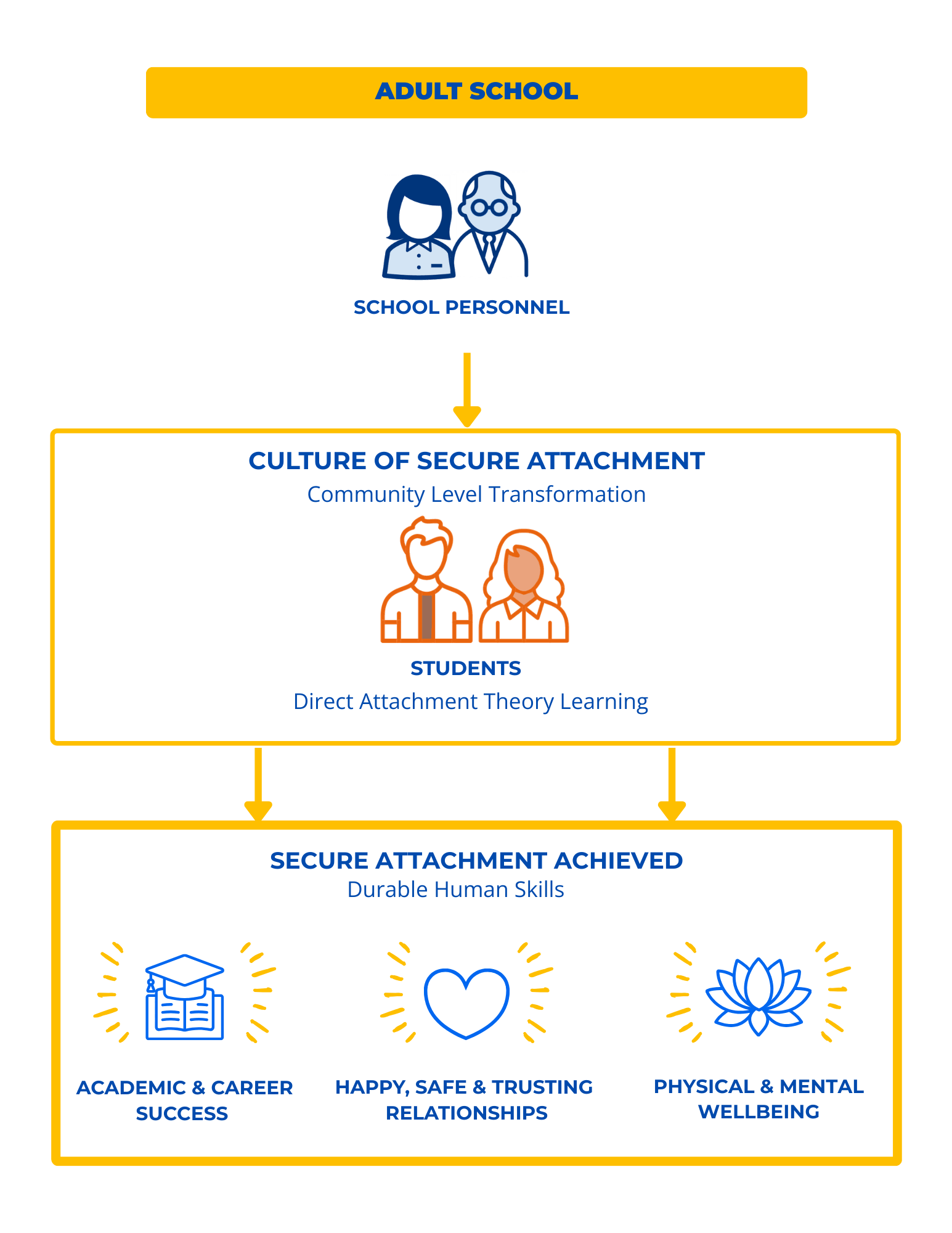
This benefits everyone in adult educational settings by promoting understanding of different relational and learning needs. This knowledge helps teachers adapt their approaches to support diverse students more effectively while recognizing their own interpersonal patterns. Such awareness creates more inclusive, responsive learning environments that accommodate various communication styles and help-seeking behaviors.
Spotlight on Research
A four-year longitudinal study by Kurland and Siegel (2020) found that attachment security significantly predicted college students’ cumulative GPA and graduation rates—even after controlling for high school GPA—revealing that the quality of students’ early relationships shapes academic success well into adulthood.
Attachment and College Academic Success: A Four-Year Longitudinal Study
written by Robert M. Kurland, Harold I. Siegel, Published by Open Journal of Social Sciences, Vol.8 No.12, 2020
Discover the urgency for attachment-based education at your school/district
In-Person/Virtual Workshops
Educator Workshops
Understanding Attachment Styles to Enhance Student Relationships
Key Objectives:
- Understand the importance of attachment in teacher-student relationships.
- Learn how attachment develops and shapes individuals over time.
- Identify attachment styles and their impact on students’ behaviors and success.
- Gain strategies to recognize and support students’ attachment needs.
Building Secure Classrooms: Attachment-Based Teaching, Emotional-Regulation, and Emotional Well-Being
A Two-Part Professional Development Series for Educators
Part 1: How Attachment Patterns Affect Student Emotional Regulation
This 90-minute foundational workshop explores how early attachment experiences shape students’ capacity for emotional regulation—the cornerstone of academic, social, and future career success. Educators will learn how insecure attachment patterns form in the home, the core wounds and coping mechanisms that drive challenging classroom behaviors, and specific intervention strategies to interrupt dysregulation and help students build new, healthier emotional responses. Through case studies and practical application, participants will develop a deeper understanding of the “why” behind student behavior and gain concrete tools to support regulatory development.
Key Objectives:
- Illuminate Root Causes: Connect early caregiving patterns to students’ core wounds, needs, and coping strategies that surface as classroom behaviors.
- Center Self-Regulation: Clarify why self-regulation—not IQ—is the cornerstone of academic, social, and life outcomes.
- Target the Chain: Show where dysregulation unfolds and identify precise intervention points to change the trajectory in real time.
- Make It Practical: Equip educators with differentiated, attachment-informed strategies that help students rewire regulation patterns over time.
Part 2: Creating a Secure Classroom Through Educator Regulation
Building on the foundation of Part 1, this 90-minute session focuses on the most critical factor in creating a secure classroom: the educator’s own regulated nervous system. Participants will explore what happens neurologically when students trigger their stress response, how their personal attachment style influences their teaching and classroom management, and why self-regulation is essential for effective co-regulation. Through experiential practice and personalized planning, educators will learn in-the-moment regulation tools they can use while teaching, strategies for creating a secure classroom environment through their own emotional presence, and sustainable self-care practices to prevent burnout while doing this demanding work.
Key Objectives:
- Deepen Awareness of Internal Regulation: Help educators recognize their own physiological stress responses, emotional triggers, and body cues that arise during challenging classroom moments.
- Connect Attachment Style to Teaching Practice: Explore how each educator’s attachment pattern—anxious, avoidant, fearful-avoidant (disorganized), or secure—influences their classroom management, relational style, and communication with students.
- Strengthen the Science of Co-Regulation: Illustrate how a calm and regulated educator’s nervous system supports student safety and regulation through mirror neurons and attuned emotional presence.
- Integrate Sustainable Regulation and Self-Care Practices: Equip educators with personalized regulation tools and ongoing self-care strategies to maintain emotional steadiness, prevent burnout, and consistently model secure attachment in the classroom.
School Counselors, Social Workers, & Other Mental Health Staff
Workshop 1: Understanding Attachment Theory to Transform Student Support
This 90-minute foundational workshop introduces school counselors and social workers to attachment theory and its powerful applications in school-based mental health practice. Participants will explore how attachment develops through early caregiving relationships and continues to shape students’ emotional wellbeing, behaviors, and presenting concerns throughout their school years. Through practical case examples relevant to counseling and social work, professionals will learn to identify the four primary attachment styles—secure, anxious-preoccupied, dismissive-avoidant, and fearful-avoidant (disorganized)—and understand how these patterns show up in intake sessions, individual counseling, crisis situations, and interactions with peers and adults. By the end of the session, participants will have a foundational framework for viewing student challenges through an attachment lens and beginning to integrate attachment-informed approaches into their daily practice.
Key Objectives:
- Understand Core Attachment Styles: Build foundational knowledge of the four attachment styles, how these relational patterns develop in early childhood, and how they continue to influence students’ emotional and behavioral functioning.
- Recognize Attachment Patterns in Student Presenting Concerns: Learn to identify how different attachment styles manifest in common referral issues—anxiety, depression, behavioral problems, peer conflict, family struggles, and academic disengagement—reframing these challenges as attachment-based needs rather than isolated symptoms.
- Begin Applying Attachment-Informed Support Strategies: Discover practical, relationship-based approaches tailored to each attachment style that school counselors and social workers can immediately implement to build trust, promote emotional safety, and support student growth within the therapeutic relationship.
Workshop 2: Attachment-Informed Crisis Response & Systems Support
A Two-Part Professional Development Series for Educators
Part 1: Attachment Patterns, Student Dysregulation, and the Power of Co-Regulation
This 90-minute foundational workshop explores how attachment patterns profoundly shape students’ capacity for emotional regulation—the cornerstone of mental health, academic success, and healthy relationships. School counselors and social workers will learn how insecure attachment patterns formed in early caregiving relationships create specific regulatory challenges that manifest as anxiety, depression, behavioral crises, and relational struggles. Participants will discover why certain students escalate while others shut down, understand the core wounds and coping mechanisms driving these patterns, and learn the science of co-regulation—how your own regulated nervous system becomes the most powerful intervention tool. Through case examples and practical application, professionals will gain concrete strategies for helping students build new regulatory capacities within the safety of the therapeutic relationship.
Key Objectives:
- Illuminate the Attachment-Regulation Connection: Understand how early caregiving patterns create core wounds and coping mechanisms that drive students’ regulatory struggles, and why self-regulation—not cognitive ability—is foundational to mental health and life success.
- Master Co-Regulation as Clinical Intervention: Learn the neuroscience of how your calm, regulated presence supports student regulation through mirror neurons and attuned connection, and discover attachment-specific co-regulation strategies for crisis intervention and ongoing therapeutic work.
- Build Differentiated Regulation Support: Gain practical, attachment-informed techniques tailored to each attachment style that help students interrupt dysregulation patterns, strengthen regulatory skills, and develop secure pathways to emotional safety.
Part 2: The Regulated Professional: Navigating Multiple Attachment Systems to Support Student Success
Building on Part 1, this 90-minute session focuses on the most critical and complex aspect of school-based mental health work: the counselor or social worker’s ability to remain regulated while navigating the intersecting attachment styles of students, teachers, and parents/caregivers. Participants will explore what happens neurologically when challenging cases, resistant families, or overwhelmed teachers trigger their stress response, and how their personal attachment style influences every consultation, family meeting, and therapeutic relationship. The session then expands to address the unique systemic challenge counselors and social workers face: students exist at the intersection of multiple attachment relationships, and supporting them requires understanding and strategically working with the attachment patterns of ALL the adults in their world. Through experiential practice, case analysis, and personalized planning, professionals will learn in-the-moment regulation tools, skills for recognizing attachment styles in teachers and parents, and concrete strategies for navigating conflicting attachment dynamics to build collaborative support systems. This session empowers mental health professionals to lead attachment-informed change from a foundation of personal regulation while skillfully managing the complex relational web that surrounds each student.
Key Objectives:
- Establish Self-Regulation as Your Foundation: Deepen awareness of your own physiological stress responses, emotional triggers, and attachment style, recognizing how these influence your clinical work, consultation approach, boundary-setting, and capacity for systems advocacy—and learn personalized regulation tools to maintain steady presence during challenging moments.
- Recognize and Work With Teacher and Parent Attachment Styles: Develop skills to identify attachment patterns in the educators and caregivers you consult with, understanding how anxious, avoidant, fearful-avoidant (disorganized), or secure styles shape their responses to student struggles, their openness to feedback, and their capacity for collaboration.
- Navigate Complex Attachment Triangles: Learn practical strategies for working with students who sit at the intersection of multiple attachment relationships—how to support an anxious student with a dismissive teacher and an anxious parent, or manage dynamics when adult attachment styles clash and create barriers to student support.
- Lead System Change Through Regulated, Attuned Presence: Understand how your calm nervous system creates safety not only for students but also for the stressed educators and defensive families you work with, strengthening your influence as a bridge-builder, and integrate sustainable self-care practices to prevent compassion fatigue while consistently modeling secure attachment across all school relationships..
Leadership workshop (Coming Soon!)
Coaching Add-Ons
Student Workshops
This workshop series empowers teens to understand and navigate relationships through the lens of Attachment Theory. By exploring the four attachment styles and developing earned secure strategies, students build emotional regulation, communication, and self-awareness, leading to stronger academic performance, healthier relationships, and greater confidence in future careers.
Secure Connections Student Workshop Series
#1 - Navigating Relationships
Overview:
This workshop aims to equip adults with essential insights into Attachment Theory, fostering a deeper understanding of how attachment styles influence their relationships. Participants will explore diverse attachment styles and learn that these styles are fluid, with the potential for growth towards earned secure attachment.
Learning Targets:
- Understand the significance of Attachment Theory in shaping relationships and emotional bonds.
- Recognize and differentiate between diverse attachment styles, including secure, anxious-preoccupied, dismissive-avoidant, and fearful-avoidant.
- Grasp the concept of fluidity in attachment styles and comprehend that these styles can evolve over time.
- Realize the potential for growth towards earned secure attachment through self-awareness and intentional relationship-building.
#2 - Moving from Reactive to Responsive
Part 1: Understanding Your Emotional Patterns
Short Description:
In this foundational workshop, teens explore how their early experiences and relationships have shaped the way they handle emotions today. Through interactive activities and relatable scenarios, students will discover why they might worry excessively, shut down, push others away, or cling harder when stressed—and learn that these patterns reflect insecure attachment styles that once served as protection but may no longer serve them well. Participants will identify their own stress responses, understand the core wounds and needs driving their behaviors, and recognize their maladaptive coping mechanisms. Most importantly, teens will learn that these patterns are not fixed—they can be reshaped into secure, healthy responses through awareness and practice, building the foundation for the practical regulation skills taught in Workshop 2.
Learning Objectives:
By the end of Workshop 1, participants will be able to:
- Explain how anxious-preoccupied, dismissive-avoidant, and fearful-avoidant attachment patterns develop based on early relationship experiences
- Identify their own primary attachment pattern and recognize how it shows up in their relationships and stress responses
- Describe the core wound (deep fear), core need, and typical coping mechanisms associated with each insecure attachment style
- Analyze how their coping mechanisms, while originally protective, often backfire and create the exact outcomes they fear (abandonment, rejection, chaos)
- Recognize what they are truly seeking when they react (connection, safety, control) and understand the difference between their needs and their strategies
- Articulate that insecure attachment patterns are learned responses—not permanent personality traits—and can be rewired toward secure attachment through awareness and intentional practice
Part 2: Taking Control of Your Responses
Short Description:
Building on the self-awareness developed in Workshop 1, this action-oriented workshop teaches teens the science behind their stress responses and provides practical tools to create new, secure patterns in real time. Students will learn what happens in their brain and body when their attachment style is triggered, how to recognize their personal early warning signals, and most importantly—how to pause before reacting automatically. Through hands-on practice, teens will learn specific regulation strategies for both “revved up” (hyperaroused) and “shut down” (hypoaroused) states, and develop a personalized regulation plan. The workshop concludes with daily practices that rewire the nervous system over time, helping teens build the self-regulation skills that are essential for healthy relationships, academic success, and future career readiness.
Learning Objectives:
By the end of Workshop 2, participants will be able to:
- Explain what happens neurologically, chemically, and somatically when someone with an insecure attachment style feels triggered (amygdala activation, stress hormones, prefrontal cortex going offline)
- Identify their personal early warning signals—the specific body sensations, thoughts, and urges that indicate they are becoming dysregulated
- Demonstrate the STOP technique (Stop, Take breaths, Observe, Proceed) to create a pause between trigger and automatic reaction
- Apply appropriate regulation strategies based on their nervous system state:
- For hyperarousal (revved up): physiological sigh, box breathing, cold exposure, bilateral movement, grounding
- For hypoarousal (shut down): energizing breath, movement, sensory stimulation, social engagement, orienting to safety
- Create a personalized regulation map that includes their attachment pattern, core wound, early warning signals, and go-to regulation tools for different states
- Implement daily rewiring practices (morning anchor, body check-ins, regulation practice, safe connection moments, evening reflection, sleep protection) that build new neural pathways and strengthen self-regulation capacity over time
#3 - Changing Relationship Beliefs
Overview:
This workshop aims to guide adults in exploring and reshaping their beliefs about themselves and their relationships. Building on their previous understanding of attachment styles, this session focuses on how these beliefs influence relationship dynamics. By identifying the origins of these beliefs and introducing a practical 21-day strategy for change, participants will gain tools to cultivate healthier and more positive relationship patterns.
Learning Targets:
- Examine Attachment Styles: Understand how different attachment styles influence general beliefs about self-worth and relationships.
- Explore the Origins of Relationship Beliefs: Gain insight into how beliefs about oneself and relationships are formed and how they impact behavior and connection with others.
- Implement a 21-Day Strategy for Change: Learn a structured 21-day approach for modifying relationship beliefs, supporting healthier interactions and personal growth.
#4 - Embracing Vulnerabilities
Overview:
This workshop aims to empower participants to enhance their relationships by effectively expressing their needs. Through a combination of theory, interactive activities, and practical tips, participants will identify common needs associated with each attachment style, practice assertive communication and active listening skills through role-playing scenarios, and learn tips and tricks for expressing needs effectively in relationships.
Learning Targets:
- Understand how attachment styles and core wounds are related to needs.
- Identify common needs associated with different attachment styles.
- Develop assertive communication and active listening skills.
- Learn strategies for expressing needs effectively in relationships.
#5 - Empower Your Relationships
Overview:
Boundaries are essential for maintaining healthy relationships and personal well-being. In this workshop, participants will explore the importance of setting boundaries in various aspects of life, including friendships, family dynamics, and romantic relationships. Additionally, the workshop will delve into how boundaries are related to attachment styles, shedding light on how our past experiences influence our boundary-setting tendencies.Through interactive activities and group discussions, participants will learn strategies for identifying, communicating, and enforcing boundaries effectively.
Learning Targets:
- Understand the significance of boundaries in fostering healthy relationships.
- Recognize personal boundaries and their impact on well-being.
- Explore the connection between attachment styles and boundary-setting behaviors.
- Develop skills for setting and enforcing boundaries in different areas of life.
#6 - Establishing and Enforcing Boundaries
Overview:
Conflict is an inevitable part of human interaction, but how we approach and navigate conflicts can greatly impact our relationships and well-being. This workshop focuses on redefining conflict through the lens of secure attachment strategies, emphasizing healthy communication, empathy, and emotional regulation. Participants will explore the influence of attachment styles on conflict resolution and learn practical techniques for embracing secure attachment strategies in their interpersonal interactions.
Learning Targets:
- Understand the concept of secure attachment and its relevance to conflict resolution.
- Identify common behaviors associated with insecure attachment styles (anxious, avoidant) in conflict situations.
- Acquire practical strategies for adopting secure attachment strategies, including effective communication, empathy, and collaborative problem-solving.
- Apply secure conflict resolution techniques
#7 - Repairing Relationships
Overview:
This workshop empowers adults to embrace vulnerability for deeper connections and authenticity in relationships. Participants will also explore how attachment styles influence their approach to vulnerability, offering insights into emotional responses and relationship behaviors.
Learning Targets:
- Define vulnerability and its significance in fostering genuine connections, with consideration of attachment styles.
- Recognize and address fears and challenges associated with vulnerability, while understanding the impact of attachment styles.
- Identify actionable steps to integrate vulnerability into daily interactions and relationships, taking into account attachment styles and strategies for fostering secure attachments.
#8 - From Conflict to Connections
Overview:
This workshop serves as the concluding session of a series exploring attachment theory and fostering secure attachment behaviors. Participants engage in reflection, identify personal growth, and discuss actionable steps for continued progress. The workshop emphasizes seeking emotional support, cultivating relationships with secure individuals, practicing mindfulness, continuing education, and peer collaboration.
Learning Targets:
- Reflection on the exploration of attachment theory and development of secure attachment behaviors.
- Recognizing progress in identifying instances of applying secure attachment strategies in real-life situations.
- Identifying next steps for growth
School Personnel Support Group

Our supportive community for school personnel is here to help!